“It’s like a culture to join the British Army, to be a Gurkha,” Chapal told me during our interview in March 2014 where we met in Hong Kong. Chapal was recruited into regimental service in 1980 in Dharan, which was one of the main Gurkha recruitment camps in Nepal.1 The eldest of three sons, Chapal was the only one in the family who joined the Gurkhas. While his father was not a British Gurkha, his grandfather used to work for the Nepalese Army. When he said that it is “a culture” to be recruited as a Gurkha, Chapal is referring to a culture of emigration (Yamanaka 2000) in that his (extended) family and relatives included some kin who joined as Gurkhas. Parker (1999) writes of his interview with a retired Gurkha officer, Major Dal Bahadur Gurung, who had served in the 6th Gurkha Rifles for the entirety of his military career. Both of Dal’s great-great-grandfathers were part of the East India Company. His great-grandfather, grandfather, father, and two elder brothers all enlisted as Gurkhas in their respective times:
When I was seven years old, my brother enlisted in the Gurkhas in 1942, and my second eldest brother enlisted a year later, leaving myself, my sister and younger brother at home. When my brothers came home in their uniforms, it was a true family occasion. Everyone was very proud, and my grandfather said I should enlist as soon as I could. The next year, when I was only fifteen, the recruiting officers came as usual looking for young men to join up. I was one of the boys selected, but my mother said: ‘No, you are too young.’ Next year when I was sixteen, the recruiting officers came back again and I ran away with them. (Parker 1999, 203–4)
Similarly, another retired Gurkha soldier, Ramesh, explained to me: “I [am] meant to be a Gurkha because I have to follow my generation” in referring to his father-in-law who served as a Gurkha in the 2nd Regiment. In Chapal’s case, he was posted to Hong Kong right after recruitment, and has since been living there for thirty-five years at the time of my meeting with him.
Having had two children who were born and who grew up in Hong Kong, Chapal’s wife works as a waitress. Chapal is now a bodyguard-driver (as a second career). He said that he has visited the United Kingdom a few times. He has also thought about returning to Nepal: “Maybe I go back home my country [Nepal] … my birthplace.” When Chapal was still active in service, he traveled back to Nepal about once every three to four years. Now that he is retired and a civilian, he makes more frequent trips to Nepal, which average once a year. Both his children are presently studying in Nepal. Throughout the course of the interview, he talked about how much the Gurkhas have contributed to the British, and for which the former ought to be remembered through memorials and other forms. He opined:
As I said before, Gurkhas start[ed] … in Hong Kong in 1948. And they put on duty, and all the Gurkhas move here, all the Gurkhas move before the 1971. All the recruits, everything. So we then fifty years of time, fifty years of time, all our three generation of people, like me. I said, three generation, you know what I mean, we spend all our time, many of our time, almost minimum time fifteen years in Hong Kong, and that’s if we work here. Everything from Hong Kong. At that time, ruled by British and the colonial government. Ya. But is still, the things what we did was the governmental, the ruler is gone, the British left already. But still the things we did, we made, is still here, continue, is still here. But, I need to say though, if the things is still used to, is still good for everyone and good for people, then why not us? There is nothing else, no, if you go find something, you want to know, you can go museum, you go somewhere else, or somewhere far, you cannot find anything … . What I meant to say is, there should be something there… . If you know, if you visit Nepal, you go to Pokhara … [they are] trying to start, there is a Gurkha monument [they are building].
Putting aside Chapal’s importunity for the need to remember the Gurkhas, he also shared later that Gurkhas were not always well regarded. He noted: “In Hong Kong, but now, there is some Chinese guys, they’re hired but maybe they don’t like, but maybe when you talk to kids, they don’t like some Gurkhas, Nepalese.” This statement is indicative of the different extent and degree to which Gurkhas in Hong Kong (and elsewhere) are welcomed or otherwise, depending on the country of residence that Gurkhas are situated in. Such reception is likewise contingent on particular structural frameworks, including policies revolving around multiculturalism, rights to remain, citizenship, and ethnic majority-minority relations among others.2
Another Gurkha, Manjul, has been to Bosnia, Yugoslavia, Kenya, Brunei, and East Timor as part of his battalion’s varied postings over the years of his Gurkha service since 1994. He enlisted into Gurkha training in Pokhara at the age of nineteen—which was his second (successful) try after his first attempt undertaken a year before in 1993. Unlike most other Gurkhas, Manjul was married eight months prior to recruitment. He was already a father of a two-month-old son before he joined the army. Nine months of recruit training formally commenced in Hong Kong two weeks after he was enlisted. Manjul was aware of this overseas posting (and for which most Gurkha recruits are not made privy to), having learned some information from his brother who was previously in the British Army and who has now retired in the United Kingdom. Manjul’s next stop after Hong Kong was the United Kingdom, and thereafter to the aforementioned countries in following his battalion’s deployment.
After recruitment, the next time Manjul saw his wife and son was four years later in 1998, given that the first long leave for new Gurkha soldier-recruits was allowed after about three-and-a-half years of service. As Parker explains somewhat similarly:
British officers faced an even longer journey if a visit to England was on the cards, and a system of long leaves evolved whereby they took six months every three years. For the Gurkhas, this suited the parents of new recruits who, on returning home after their first three years, would find their bride waiting for them for a prompt marriage and hopefully, before the leave was over, the bride would be pregnant, and the child would be three the next time he or she saw the father—if indeed he came back. (1999, 65)
Manjul recounted somewhat bemusedly to me: “It’s, the interesting thing is four years after I’ve seen my wife, and four years after my son is running everywhere, and I say that your dad is finally home … ‘Who are you?’ He say like that you know.” As a result of Gurkha service, Manjul noted, some Gurkhas’ plans for raising a family were interrupted. Manjul explained in detail:
You know they married, example, when they married recruiting time. Then their family promotion to the twelve, thirteen, fourteen years after, then that long gap. Then some of the, didn’t make the chance in their baby. That’s why the you know the they hurt the baby you know, forever. They lose the baby. Then, just one husband and a wife. Because of the separation. They want a baby but, they can’t.
The reference to twelve or more years by Manjul is made in relation to the number of years that Gurkhas had to fulfil before they were allowed to have their families join them in the married quarters of their army barracks. Permission to have their family members live with them was also contingent on their respective rank in the army (Ku et al. 2010). Given these various military regulations and other accompanying structural constraints, raising a family for some Gurkhas was not always easy due to many years of separation and differentiated rank-and-file treatment in the regiment. In Manjul’s case, he was only allowed to bring his family to the Gurkha barracks in Brunei in 2005—just over a decade after he was enlisted. This was because he was promoted only then and was therefore allowed to bring his wife and children to Brunei where he was based. Fifteen days later, however, he received news that he was to be posted to Afghanistan for six months. This left him with a mere two months since his family first joined him in Brunei, before he was to depart for Afghanistan thereafter. While based in Brunei, Manjul also took the chance to travel with his wife to nearby countries, including Singapore, Thailand, and Malaysia. In Singapore, he visited the Gurkha camp of the Singapore Police Force, where his sister and a fellow Nepalese Gurkha were based.
Manjul is now working in the United Kingdom. Though his wife and he are eligible to apply for British citizenship, both are not keen.3 His wife and children, however, do hold the “indefinite leave to remain” (ILR)—which means eligibility for settlement in the United Kingdom. Although he noted that the children would be better off in the United Kingdom than Nepal—“when they came here then they study English in school. Then they have all English friend[s]… . If they going to Nepal, there’s nothing. You know. They don’t study in Nepal, they don’t know the Nepal… . They have a future in here, they don’t have future in Nepal”—Manjul himself would prefer to return to Nepal. When I probed him about how much longer he plans to stay in the United Kingdom, he expressed his quandary given the political situation in Nepal at the time of our interview:4
Is the dependent on situation you know. In Nepal is the now, very difficult. You know the, I love my country. I love my village. I love my com- … you know the community. But there is now very difficult. There’s you know, some of this, is the politics and is you know, no good for Nepal… . I thinking I’m back to Nepal. Because I am born there, you know. If, if the politics is good, then I’m not going to stay here. I back to Nepal. [laughs]
Experiences relating to regimental recruitment, notions of home, belonging, Gurkha children and their education and future, transnational Gurkha or kin ties, among many others, are replete and recurrently raised by my interlocutors throughout the course of my fieldwork. I provide an overall background to the enlistment, posting, and military and other experiences of the Gurkhas who have traveled across and lived in different places around the globe during different phases of their lives. I draw on a wide range of narrative accounts shared with me by Gurkhas and their family members, including my examination of other secondary sources, which I analyze in this and the next chapter. The varied experiences and perspectives of Chapal, Manjul, and many others constitute my analytical focus. By laying out the multiple processes and obstacles toward being recruited as a Gurkha, including their overseas postings and life thereafter, I extend my previous discussion by mapping out the different routes that young Gurkhas first took as they leave their home in Nepal. Given the recent turn to possibilities of enlisting female recruits into Gurkha service for the British Army, I also discuss issues related to gender positions and how recruitment of Nepalese women has been debated and received. In so doing, I take Gurkha as a gendered category of analysis beyond well-debated notions revolving around masculinity and bravery among Gurkha men.
Over and above popular if not stereotypical constructions of the Gurkhas as brave warriors, their multiple work and life trajectories have clearly extended beyond national boundaries (Pries 2001) within the wider global security network. These trajectories and movements include the periods and contexts from recruitment to overseas regimental and other postings as security contractors (see for example, Chakrabarti 2008; Chisholm 2014; Coburn 2018; Thule 2011; Vines 1999) and building families across borders. Acknowledging and analyzing these cross-border movements and settlements will therefore shed light on their lives as migrant warriors. I am interested in addressing and problematizing how they assess varying sentiments toward the country or countries in which they have trained and lived, and how these together reflect the different ways to approach bracketed belonging beyond their military and police experiences. In sum, the dynamics of leaving their villages or other towns in Nepal, and heading for early days of military and police training in Singapore, Hong Kong, Malaysia, or the United Kingdom in their first years in service pertinently illustrate and illuminate the beginnings of their different or multiple migratory paths. These in turn affected the timing and ways in which they settled down and started having children, and where they later would choose to retire. These are among many other issues that are, with some exceptions, seldom deliberated on in earlier and current literature on the Gurkhas. As a response to Gould (1999, 4), who proclaims that the “void at the centre of all histories of the Gurkhas is the voice of Gurkhas themselves,” I therefore address these important themes in this book.
What are their aspirations as they embark on a Gurkha career, and subsequently a second career in the security and tourism-related industries in the region and beyond? Where do they regard their homes to be, and what remembrances of the Gurkhas and of Nepal do these warriors possess? What considerations come to their minds as some of them choose early retirement from service, to return to Nepal with their children, or to think about retiring in Nepal in their twilight years after a long period of stay outside of their homeland? How can one make sense of these varied decisions and pathways, routes and roots vis-à-vis the wider literature on migration, home, aspiration, and mobility? As I systematically engage with these interpellated queries, I show how their lives as migrants and not merely as soldiers in the fore are affected by a host of both military and paramilitary vicissitudes. My engagement also considers the varied roles of nation-states and their accompanying governance structures that determine Gurkha mobilities. Together, these contexts and rules provide the backdrop that render them as a crucial category of para/military-labor migrants within the wider diasporic literature. In sum, I discuss the lives of Gurkhas and their families beyond their global reputation as warriors. In doing so, I therefore indicate how the Gurkhas’ life history experiences and their aspirations—the multiple layers, convergences, and divergences—and manifold mobilities or immobilities may be conceived and interrogated through the lens and conceptual apparatuses of migration, bracketed belonging, and other cognate scholarship.
(Do) I Want to Be a Gurkha
Manjul’s first encounter with Gurkhas took place when he was a little boy of about five or six years of age. The figure of the Gurkha as a strong, fit, and successful migrant was poignantly carved in Manjul’s memory. He described the initial encounter to me:
Yeah it’s the why I’m join the Gurkhas is the Gurkhas is when I born, like the … I’m, my age is five or six years, then I heard in the Gurkhas that time there is this some of the senior person is the, he is the British Army … In my village. Then he say that I’m the captain. He said the Gurkhas’ captain. And he looks very handsome and good man! Then the becoming one of the villager another senior than me, he join also the army, lots of the British Army, we have in that village.
This “culture of emigration” as earlier iterated refers to the tradition of young Nepalese men who follow their male kins’ footsteps—be they their fathers, uncles, brothers, or cousins—in taking up Gurkha service as a form of livelihood. Naveen, who was recruited into the British Army in 1991, noted: “Initially those who were serving in Gurkhas, their family background completely Gurkhas, you know. Like my father who was in Gurkha before, and when he retired, and my first and second brother.” Consequently, such a tradition of Gurkha enlistment and service has fostered a culture of emigration whereby “Gurkha connections” have been formed over time. These connections generate extensive information networks that both inculcate the positive aspects of serving as Gurkhas, as well as shore up other stories of their migratory-military experiences. Badal, whose grandfather was a Gurkha, had this to say where recruitment is concerned:
Even there are army family around and all. So they always have this mindset that okay, as a son of a Gurkha, a grandson of Gurkha, at least you should try [to be recruited], at least you should try to… . Luckily for me, maybe you know I was fat, and they always thought I’ll never be a Gurkha? But I was good in study, so they never force me.
Notwithstanding Badal’s family history and how he did not (have to) follow in the footsteps of his grandfather, such networks and tradition of Gurkha recruitment and emigration that my interlocutors have shared are broadly similar to other migratory niches and occupations. Occupational provincialism, coupled with economic motivations to migrate, are consonant with other similar studies on overseas migration. These studies examine how and why migrants seek to better both their personal situations as well as familial circumstances (Des Chene 1992; Kumar 2004; Low 2014).
Being a Gurkha, and serving in countries such as the United Kingdom, Singapore, Hong Kong, or elsewhere proved to be economically favorable stints. For one, their service helped construct the figure of the successful migrant. This figure was embodied in Gurkhas who returned to their villages over the period of their long leave. Manjul illustrated this in detail:
We grown up like seventeen or sixteen, and that time my brother also he join the army. That’s why the, when they come back, they’re late you know. Three years after they can take leave then they say I think you, you also join in the British Army, and they say like that then why? And if you, they say that it’s not good. At least you have the job. That’s why you can survive. So we have a good history, the Gurkhas’ history, now around 100 year plus. 150 years now, mostly say like that. Then it’s still I’m you know the just quite, the not very interesting, just little bit of dangers there, then when I grown like eighteen years then I decide ok, and I’ve seen lots of the not my village or the village of there, there is also all the British Army, and the they have the huge, huge houses they build themselves. That’s why he got the job, he got lots of money, then he afford to build their house. A nice house and nice building it looks very good. And but we don’t have job that time then how do we build that?
Apart from having encountered the figure of the Gurkha as a child, and in addition to his own brother’s experience of serving in the British Army, Manjul saw that Gurkhas who had returned in-between their service had accomplished a fairly good life in owning property. This was registered through the huge houses that they could afford to build, along with “lots of money” that only being a Gurkha could earn in a situation of limited job prospects in the country. Jishnu claimed to be the first Gurkha in his family. He enlisted in 1980. He explained that although he did well in school and sports and that his teacher had dissuaded him from joining the army, he enlisted in any case because he had to support his family:
Frankly speaking, I’m the first, I was the first generation to be a Gurkha, to be enrolled in the Gurkha. And my teacher asked me, requested me many time not to go to the Gurkha because I was very good in the study, and I was the school union leader, and I was good in sports, so my teacher asked me not to go there. Because with my situation, not very good, I cannot go into university, so after high school, I just wanted to join the army. That’s all, there. Because of my family situation… . I have a big family. I was the youngest one, and so I had no choice but to make a quick money, support my family. I could join the army.
His decision to join the army was also prompted by his remembrance of Gurkhas who had gone before him, and who, not unlike that of Manjul’s recollection, were successful when they returned:
They told me, you have very bright future here. But you know, the young Gurkhas, they used to live and show off everything. It’s really I think one of the attraction that attracted us in the village… . Not that kind of chance to have the watch, have new clothes and anything. Anything, you get it… . And the radio… . At that time, Panasonic… . And Kelvin, because I joined the army, that really helped a lot, a lot to my family’s situation at that time, financial situation.
Calling the current generation as “rich young Gurkhas,” Jishnu compared them and his generation. He saw that while he was not always able to visit home as frequently, the current Gurkhas are able to do that more often. This is due not only to changes in regimental rules concerning leave cycles, but also attributed to the somewhat improved affluence of Gurkhas today. Such a context again adds to the image of the successful migrant, of which Gurkha service has been able to produce over time. Jishnu’s own experience as a migrant who has done relatively well is seen through the material goods that he himself had been able to bring home on his visits—a Panasonic radio, a Yashica camera, and a Seiko watch—for which he felt “proud.” At that time, the ability to buy these commodities and to bring them home either as possessions or as gifts for their families was seen as rare. Similarly, Lakshan’s view aligns with the image of the successful migrant:
Main, main impression is because you must have seen people coming back happy. Happily coming back to see the family with the money, nice clothings, nice personal equipment, like radio. Oh, nowadays you think, oh very easy. So you think you have a lot of money, you can earn a lot of money. So that’s why they become very attracted and eager to go.
These material objects therefore constitute a marker of success after the Gurkhas leave for service, and then return to Nepal on short-term visits. In Kumud’s words: “There’s different style … There’s different style, different environment, different feeling, different image.” Dervla Murphy, Irish author and touring cyclist, crafts a vivid description (for which I quote at length) of the transition from Nepali youth to Gurkha serviceman who had done well as a migrant:
Sometimes one sees scared, barefooted youths from remote hill villages coming to the airfield, carrying battered little tin boxes of meagre possessions, on their way to join those elder brothers, cousins and uncles who are “doing well” with the British Army in Hong Kong, Borneo or Malaya. Then one often sees Gurkhas returning on six months’ leave, after three years’ service, and invariably they look sensationally spruce among their welcoming family. The grimy stay-at-home wear unwashed, fraying garments, while the well-scrubbed soldiers are attired in starched, neatly-creased khaki shorts, flowered bush-shirts and broad-brimmed straw hats. And instead of the modest little tin box with which they departed from home they now possess at least four huge padlocked trunks. These, of course, are left for their wives, mothers or sisters to carry … while the Returned Hero strides importantly ahead, an expensive camera slung over his shoulder and a raucous transistor screaming in his hand as he chats with those male relatives who trot respectfully beside him, carrying light pieces of hand-luggage. Usually at this stage the hero’s pocket is full of newly-acquired rupees, for he will have paused long enough on the airfield to sell a selection of excellent Swiss watches and Japanese pocket-transistors at incredibly low prices. (Murphy 1967, 59)
Over time, however, the capacity to purchase these items have now become the norm rather than the exception.
That said, and even if Gurkha salaries were and are relatively meagre as compared to their British counterparts (Uesugi 2019a), successful recruitment into Gurkha service not only offered a better economic livelihood for Nepalese men. To be enlisted into the Gurkha brigade was also regarded as an achievement and thereby brought pride to the family. Such pride is evident in the case of Dhruba who proclaimed, “As a Gurkha, it’s hard work and if, because you don’t get the promotion. You get good name, if, cannot, so get nothing. Name of Gurkha also, let it be. [laughs] … our ancestors was very great and very good name and [I] want to effort [strive] to keep that name.” Furthermore, Badal also noted how he and his family were regarded, especially when people around them knew about their Gurkha lineage. He said, “And, growing up in a Gurkha family was kind of good in a way. Because the thing was, especially if you look at Nepal, and the people look at you different. Then oh, you’re the grandson of Gurkha. Like you know how they talk—like maybe it’s the financial status.”
Being proud of one’s Gurkha ancestry or lineage and thereby to serve as one is however not always the case for some of the other Gurkhas I spoke with. Manohar, as an example, shared that he was compelled by his father to join the service as a Gurkha—”My dad forced me to join”—as their family was poor and there were no other better economic options. He lamented, “Actually before, when I was young, I, I was uh, very upset. But there is no choice. Because my family is very poor.” In a similar way, Ujesh explained that at the time of his enlistment in 1969, there were simply no other opportunities to consider apart from potential livelihood as a Gurkha arising from economic necessity. Without a foreseeable future in Nepal itself, Gurkha recruitment was in fact a palpably feasible option. It need not necessarily stem from his family’s or his own choice per se: “We are actually compel[led] to go ourself, outside Nepal. Because there’s no future in the country. No jobs. So, it is everyone, in everyone’s mind they want to leave the country and go somewhere to do work. No matter what other job they get… . And they enjoy that.” Correspondingly, Kamadev shared that “mainly in Nepal, people are unemployed, that’s why we liked to join the army … that was a decision to survive.” Ujesh further explained that while some families continued with a tradition of Gurkha service, others did not: “They, some are, some have none. But some have link to, their forefathers, grandfathers. Because they all, one person used to be up, by the Gurkhas.” He later pointed out that there was a family in his village where out of eight siblings, six were working as Gurkhas in the British Army. His friend and colleague, Lakshan, who was also at this interview with us followed up on this point. Lakshan considered it a fortunate situation where finances are concerned: “Yes, more than six. Very lucky. Some you know, they got all their sons in the army. And they very lucky because financially they in very good health for the family.”
Lakshan was speaking as someone from a Gurkha lineage that threads through a few generations in his own family. As the only son, he recalled, “Ya, but people do get the forefathers in the army. My father was in the army when my grandfather was in the army. But after my grandfather, my great great great grandfather was in the army.” Such a lineage proved to be helpful where the British officers were concerned, as Lakshan later elaborated:
But again, also those reporting officers and British officers, they do actually trust people or rely or they relate those close people in the army before. So I say my grandfather was in the army. “Oh really?” … Ya. So they do actually, what you call, respect. Ya. So if you have a father in the army who has done very well, then it’s a good opportunity for you, even nowadays, to be you know, be high rank. But if your father, your father was a very bad guy, then you are most not likely [laughs]. “Oh, I know him! Oh, he’s your father? I know him!” [laughs]
The Gurkha reputation—both of tradition and lineage, as well as of their standing in the army—therefore engenders not only recruitment for some families in following the footsteps of their various male kin. Such reputation is further enlarged precisely because of others who have gone before them. Lakshan’s narrative exemplifies the importance and usefulness of having a Gurkha “family line,” which led the British to hold him in good regard given his family history. Keeping the good name of the Gurkhas, as Dhruba mentioned above, is thus a pertinent practice that has lasted over time as well in the culture of Gurkha service with the British. During the time of his Gurkha service, Vasava had trained and worked in Hong Kong, Brunei, the United Kingdom, Fiji, Australia, Malaysia, and Singapore. He explained why he was amenable to Gurkha recruitment:
In that time, our country, no transportation, only train, no motor, no roads… . When my children hood [sic], I didn’t see any car, any taxis, any buses… . Then that time, then my father and my grandfather told us because the Gurkha is good, if you die, die… . If you survive after the pension, you get pension, they will give you pension so I will get benefit too. Then my concept, when I join the army, pension is from Hong Kong.
For Vasava, being a Gurkha in the context of retirement and the ability to provide for oneself through the pension motivated him to enter the army. Having a grandfather and father who both served as Gurkhas, he later shared with me that joining the British Army was akin to “heritage, you know … Yeah, family heritage.” Tradition, lineage, heritage, and the culture of emigration based on the above accounts stand alongside one another in illustrating the continuity of Gurkha recruitment among Nepali youths and across different generations.
What is interesting about Yamanaka’s (2000) “culture of emigration” in this context is that over time, Gurkha recruitment was no longer the preferred route of emigration. This is precisely because of Gurkha recruitment and service over the past several generations that led to better lives for their offspring and subsequent generations. With each generation faring better due to Gurkhas and their service that generated sufficient funds and resources for improving their livelihoods, and opening up educational paths for their children, the later generations are therefore much more highly educated. The need to be enlisted as Gurkhas subsequently becomes less exigent. This view is shared with me by Uttam and Parijat. Where Uttam pointed out that he would not mind being a Gurkha all over again, he also noted that the current younger generation would not consider joining the army as an option. Similarly, Parijat opined that the younger generation would plan their studies according to whichever field is more marketable. This for him was very different from his generation, in terms of plans to join the army for their future. As Parijat related to me: “Somehow it’s come to my mind, like everybody is going to join the British Army, why don’t you try? I have a goal that I can meet, that was it. My father, me, is two generations [of Gurkhas].”
Parijat and Lagan both joined as Gurkhas in 1973, and subsequently retired in 1999. Parijat’s father used to serve in the British Army, and had retired back in his village: “He loves his property, enjoy living in the village. He is seventy-nine now, he is still going strong.” In Lagan’s case, his grandfather served in the Nepalese Army, while his father was a soldier in the Indian Army. But the sons of both these respondents did not follow in their footsteps to undergo Gurkha enlistment. At the time of my meeting with them, Parijat’s son was pursuing his bachelor’s degree in Sussex, while Lagan’s two sons “sadly” did not wish to join the army, and therefore “the tradition is stopped” as was recounted to me. Parijat further reminisced, “In our time, when I joined the British Army and I come back home, in the village, oh! Ex-British Army having a good time. You can have few things where the people in the village don’t have. So we’d done proud, but not anymore [laughs].”
Although Parijat’s account above leans toward an example of what successful migration and returning home would look like, such a mentality, according to him, is no longer as desirable. This is because the “young generation have a different mind” about Gurkha service and military labor, as Parijat later opined. As commanding officer of the Catterick camp where Gurkha recruits are sent for training, Capt. Anderson notes that “in the past joining the British Army was definitely the only way out of Nepal. That’s not true now.”5 In gist, “they’re all educated now and they prefer to all go to the other industry, not the military,” remarked Nishad, another of my respondents. Nishad’s response is indicative of some measure of upward mobility for the younger generation given that they are “all educated now” as compared to earlier Nepalis who received little education during their time.
I suggest that while there are still practices and aspirations to be elsewhere for educational pursuits and thereafter for work, the culture of emigration therefore still exists. However, it operates in a different form in a newer context of many decades of Gurkha service and the expansion of the wider job markets in the region. For many years, Gurkha service with the British have provided crucial sources of income for the subsistence of their families back in Nepal based on cattle herding and terrace farming, coupled with pensions that Gurkhas receive (Yamanaka 2005). Gurkha service has also brought about some forms of horizontal if not upward mobility and (aspirations for) higher living standards for the next generations (cf. Lan 2020; Tran, Lee, and Huang, 2019). The latter are able to pursue higher education, unlike their Gurkha fathers, uncles, or brothers. In place of the Gurkha pathway are such other options or aspirations, including pursuing a degree in nursing in Australian universities (as is fairly common among the daughters in Gurkha families; see for example, Pariyar 2019), or further education elsewhere, including the United Kingdom as an option since some of the Gurkhas have worked there and have obtained the IRL as mentioned in an earlier chapter.
In problematizing the culture of emigration, one acknowledges and appreciates the concatenation of a number of factors that lead young Nepali men to join Gurkha service borne out of necessity, tradition, or volition. Aside from family tradition in which a Gurkha lineage exists and persists in some families in Nepal, economic conditions and the lack of any other desirable opportunities for work and for sustaining families are also reasons why young Nepali men aspire to be Gurkhas. These reasons are further conjugated with the image of the returnee Gurkha who seems to be doing well, and thereby explain why Gurkha enlistment has persisted for more than two hundred years. Even if enlistment figures may have seen their fair share of highs and lows over time, and even if retired Gurkhas and widows have lobbied tirelessly over the years to obtain more substantial pension funds, Gurkha recruitment continues today. In fact, female enlistees have begun to join as well.6 The change in recruitment direction to include women came in the wake of the election of Nepal’s first female president, Bidhya Devi Bhandari in 2015. This itself is unprecedented, given especially the context of Nepal as a traditionally male-dominated society. Beyond this new direction in welcoming female applicants, the change is also enacted as a result of recruitment crisis in the British Army. As the UK defence secretary Gavin Williamson notes: “The Gurkhas are renowned as one of the best fighting forces in the world with a proud history of serving Her Majesty, and it is right that women have the opportunity to serve in this elite group.”7 In order to manage the lack of enlistees, the army had in 2016 lifted its ban on women holding frontline ground fighting positions.8 At present, there are about three thousand Gurkhas in the British Army. By opening the doors to women, the army hopes to add another eight hundred Gurkhas to the fold. New female soldiers will form a new infantry battalion as well as new units of communication experts and engineers.9
The British Army had earlier floated the idea of recruiting female Gurkhas in 2007, but the plan was later rescinded, citing reasons of impracticality.10 This notwithstanding, a few Nepalese women have joined the force by relying on their British Overseas National passport privileges. The move to now include female applicants is also welcomed by some members of the Gurkha Army Ex-Servicemen’s Organisation (GAESO) in Nepal. The president of GAESO, Krishna Kumar Rai (a former Gurkha), says that it is a “matter of pride” and an important departure from an earlier belief that the presence of Nepalese women in the brigade would “destroy its comradeship.”11 The president of GAESO’s Kathmandu District Committee, Sunita Gurung, states: “It’s a moment of happiness for many Nepalese women aspiring to be the part of elite British Gurkha soldiers whose selection will be conducted in Nepal.” Furthermore, she adds that “it’s a big opportunity for Nepalese women to get a prestigious job and earn a handsome income in the United Kingdom.”12
While the foregoing discussion and reportage have portrayed positive reception of female recruitment, female hopefuls themselves are somewhat hesitant to let others know of their intentions given the unconfirmed news.13 They are also fearful of being ridiculed. As reported recently in the Kathmandu Post in February 2019,14 some women have already begun training in preparation for recruitment selection (see also, Stanik 2019)—training under the same set of criteria that men are expected to fulfill. Training centers such as the Salute Gorkha Training Center in Kathmandu, a branch at Basundhara, has admitted female trainees for the first time. Although some of the aspirant females come from nonmilitary family backgrounds, there are others whose father or elder brother was/is a Gurkha. Tsheden Lama, who commenced her training since early January 2019, has yet to inform her relatives about her Gurkha aspiration. Instead, she told them that she was enrolled in some preparatory classes before beginning her university studies. The reason for not telling them was because she was afraid they would “look down on her choice to recruit in the military.”15 Another trainee, Riya Shrestha from Budol, Kavre, said: “I came to know that the British Army is recruiting women through social media, after which I googled for the training centres where I can prepare myself for the competitive recruitment process and this is how I ended up here.”16 Interestingly, the Indian Army has recently begun to recruit women. Vacancies are available for Nepali women to join the Military Police. Nepali youths have been recruited into the Indian Army’s Gurkha Regiment since 1816, traced back to the rule of the East India Company. To date, more than 3,200 Nepali nationals are serving in the army, with many thousands of veterans who have since retired and are presently receiving pensions.17 Online applications were opened in July 2020 to eligible Nepali women, following an announcement made by the Indian Embassy in Kathmandu.
The new drive for female recruits to join as Gurkhas under the British shores up two broader points of contention in terms of Nepal-UK relations, and of gender relations in Nepal. On the one hand, public discourse on Nepalese young men being drafted into Gurkha service for a foreign power has been somewhat frowned on. In 2013, a parliamentary committee of the Nepalese government had put in a recommendation to the government to slowly reduce and end Gurkha recruitment into the British Army.18 On the other hand, however, the Gurkhas’ global reputation as brave and loyal soldiers persists in wider Nepalese discourse and is still harnessed as a source of pride and continued legacy. Furthermore, while growing numbers of women aspire to join Gurkha service—and which is an important step forward in Nepal’s traditionally patriarchal society—their hesitance to talk about such aspirations openly simultaneously serves as a reminder that Nepal might not as yet be ready to comprehensively rethink military service, a male-dominated industry, as an avenue for female participation.19 This is in spite of the Nepali Army, which has included women in general service roles since 2004. Plans for female recruitment have garnered negative reactions from Nepali lawmakers. Some senior Nepali politicians point out that as the current treaty with the British government only stipulates the recruitment of male Gurkhas, the female recruitment process should be stopped immediately. Additionally, the House of Representatives noted, “The government must review the treaty on the recruitment of Gurkhas and implement Nepal’s foreign policy and ensure that it is in the spirit of the Constitution of Nepal and its democratic system.”20
In March 2019, the Nepali Parliament canceled recruitment plans for female hopefuls to join the British Gurkha Brigade.21 It cited the reason that the timing was not right owing to ongoing issues revolving around pension and other compensation issues affecting ex-Gurkhas. It was later reported in March 2021 that talks about Gurkha female recruitment were ongoing, as noted by the British ambassador to Nepal.22 These notwithstanding, plans for female recruitment if eventually approved might in the longer run result in a repositioning in Gurkha families from split- to dual-wage earning household. Such a change on household income would also depend on whether female inductees are married to Gurkha husbands, or if rules regulating the prohibition of (non-Gurkha) wives of Gurkhas to work while living with their husbands in the army barracks might be revised or not. The scenario for retired Gurkhas is somewhat different. Among my interlocutors, most if not all Gurkha wives hold either full- or part-time jobs alongside their husbands who have embarked on their second post-Gurkha careers. This group of retired Gurkhas and their families, therefore, constitute dual-income households as opposed to some of the active Gurkhas I spoke with, or Gurkhas who used to be in service prior to their retirement.
In these varying contexts then, the trajectory and role of the male sojourner also shifts (cf. Seo 2019; Werbner and Johnson 2011), depending on the point of his career in the armed forces. The case of Gurkha families (both during active service and after retirement from the forces) therefore serves as an important intervention and critique of the image of the sole male sojourner. In their case, being the sole male wage earner at the beginning of their Gurkha career does not simply imply that women are not able to work outside of the home on their own. Neither is it a case of clear gendered division of labor that attributes men as contributing to the public sphere as waged laborers while the women reside within the private or domestic realm of family life. Instead, it is due to the military rules of prohibiting women from joining their Gurkha husbands at first, and then prohibiting them from taking on a job after joining them, that bring about split-labor households for younger Gurkha families at the outset. Wives of retired Gurkhas I have spoken to hold jobs as teachers, museum staff, cleaners, and other occupations in the food and beverage industries, among others.
In sum, one may approach an analysis of Gurkha as a gender category to consider beyond masculine physical traits of strength and resilience other broader structural resonances and gender positionalities. As discussed above, the varied dimensions of gender-resonant issues revolving around Gurkha recruitment, military and legal domains of interest, and migratory trajectories demonstrate how one can and should maneuver beyond the staple figure of the indomitable and loyal Gurkha. Approaching “Gurkha” as a gender category reveals and sheds further light on male-female relations across different spheres of social life. They include (1) British Army and the recruitment process and guidelines of whether females should play a role in frontline combat positions; (2) how potential gender discrimination as preempted by the British Army illustrates the involvement or invocation of the law that intertwines with military policies and practices; (3) Nepali gender relations in a country that is traditionally steeped in patriarchal outlook and everyday life; and (4) how gender relations and the image of the male sojourner lend further analytical avenues to rethink shifting forms of split-labor and dual wage households resulting from Gurkha service, and at different points of a Gurkha’s career path.
The Recruitment Process: Criteria, Experience, and Pathways
Manjul talked about recruitment and overseas posting, which determined the Gurkhas’ future trajectory and (migratory) circumstances and where he would serve and live:
Manjul: I mean, the Singapore police. In Nepal, selection at the same time. That’s why the Singapore police trained by in Singapore. They have their recruit company in Singapore right. But very easy you know we split the British soldiers here, the Singapore police here. Then they announce the same time …
Kelvin: Same time?
Manjul: Yeah, say the number-wise, like 2116, go here, 2117, go here, Singapore. 2118, British, 2119, go to Singapore.
Kelvin: Ah okay, okay. So your friend didn’t end up at the Gurkha side.
Manjul: Yeah, my friend is gone to Singapore [Police Force]. And I go to … split yeah.
Kelvin: Right, right right. Okay.
Manjul: Yeah and that’s right and we are separate. He went to Singapore. He said, “You know, you have a good life in the UK. I never good life in the UK [laughs], you have a good life … you have thirty-two years, forty years in Singapore, funny, he said. You know can’t I do these thirty-two years, we don’t have thirty-two years, at least we have twenty-two years in Singapore.” And how long they doing? Maybe twenty-two years? Maybe thirty years?
This interview segment illustrates how military service and the initial posting after recruitment essentially determined the longer-term trajectory of where Gurkhas could eventually work and live. In a way then, bracketed belonging—here based on recruitment trajectories—would have already been fostered from the outset of a migrant Gurkha’s career. As I have iterated previously, being posted to Singapore meant that Gurkhas had to, by the rules of the SPF, retire at age forty-five or earlier. Accompanying their retirement is a mandatory rule that all family members and the Gurkha himself would have to return to Nepal. They would not be allowed to continue their residence in Singapore after the Gurkha’s police service concludes. In contrast, those who were posted to Hong Kong or the United Kingdom faced different pathways of settlement. Due to changes in the rules in each country over recent years with the former providing the right to abode, and the latter the right to remain, or the IRL, these respectively meant that Gurkhas who have retired can exercise the option to remain in either of these two countries.
I would also add that while earlier generations could not exercise any option pertaining to which country they would be posted to, Hiresh—who was posted to the Singapore Police Force in 1978—pointed out that one could now state his preference in regard to postings:
Kelvin: So only after recruitment then you know where you are posted to. UK or Singapore.
Hiresh: Those days. Now …
Kelvin: Now you can say your preference.
Hiresh: Not preference. Yeah, now it is a preference.
Kelvin: You can indicate yeah? It is a preference.
Hiresh: No, because they have a problem here, in the recruitment you know? In fact, nobody wanted to go. Like that, if they don’t use the current procedure, nobody like to go Singapore. That was the problem. Because of the salary, because of the privilege, those things. Who wants to go now?
Kelvin: So people know now?
Hiresh: People, after selecting, I don’t know this year, few wanted to go. The following year they changed the rule. And what they did is, the first, the very beginning they are asked to fill up the form, that where you want to go.
Kelvin: Ahh, that’s what they introduce.
Hiresh: The system they introduce. You want to go to British Army or you want to go to Singapore? Ok, now it is much more clearer.
In any case, both military and paramilitary institutional structures govern the locales of residence after retirement, including where Gurkha children are allowed to continue their education or not, or to find a job in whichever country that permits their stay beyond their Gurkha father’s service. Resultantly, sentiments and constructions of “home” and of belonging are therefore contingent on these aforementioned circumstances. These different contexts provide a range of varying experiences that lend analytical fodder toward unraveling and critiquing the binary of home/hostland in more nuanced and concrete manners as earlier discussed.
Gurkha recruitment is an arduous and physically strenuous process that takes place over a few rounds from registration to regional selection, and central selection. As explained on the British Army’s Ministry of Defence website, Gurkha recruitment comprises “free, fair and transparent” selection for enlistees for either the British Army or the Singapore Police Force between the ages of eighteen and twenty-one.23 For 2021, the targeted number of recruits was 218 for Britain’s Brigade of Gurkhas, and 140 for the Gurkha Contingent of the SPF (GCSPF). For 2022, the respective targeted recruitment numbers stood at 196, and 140. In the following year, 200 potential recruits were targeted for Britain’s Brigade and 144 recruits were targeted for the GCSPF.24 Over the decades, recruitment numbers have shifted; in 2005 for example, 230 positions were available for the army and 77 for SPF,25 while in 2014, 126 places were available for the army.26 Applicants first register either at the British Gurkha Dharan (BGD) Old Ghopa camp for those from districts in Eastern Nepal (including Jhapa, Sunsari, Morang, Dhankuta, and others), or the British Gurkha Pokhara (BGP) camp for those from districts in Western Nepal (including Tanahun, Gorkha, Kaski, Lamjung, and others). Current selection rounds will conclude by December 2024 for recruitment into the GCSPF, and by February 2025 for the British Army.27
Part of the grueling Gurkha recruitment process involves applicants completing a series of physical tasks. These tasks are differentiated for those interested to try out for the British Army or the GCSPF. For the former, PRs (potential recruits) are to complete six heaves and to carry out a mid-thigh pull test at registration. As for the latter, PRs are required to complete eight heaves. For both groups, failure to carry out these tests successfully results in PRs not being able to register.28 Successful registrants will then move on to the next round, the regional selection, which is held either in Pokhara or Dharan. The physical assessment criteria for regional selection (as of 2020) includes an eight hundred meter run under two minutes and forty seconds, a “Repeated Lift and Carry” test in which one carries a twenty kilogram weight for thirty meters and then runs another thirty meters without the weight in under one minute and fifty seconds. Further tests require a minimum of twelve overarm heaves, a medicine ball throw of over 3.1 meters, and a mid-thigh pull of one hundred kilograms. The third task is only applicable for those applying for the GCSPF, and the last two tasks are applicable only for those applying for the British Army. An interview with a Nepali and a British Gurkha Officer forms part of regional selection. Both officers will ask candidates questions, including knowledge of the Gurkha brigade, notions of commitment and teamwork, resilience and integrity, among others. Successful candidates from the regional selection will then move on to the Central selection round, which again contains a series of physical, educational (English and mathematics), and medical assessments.
Gurkha recruitment comprises as well the famous doko race in which one carries a twenty-five kilogram basket on his back while running uphill on the hilly terrains over a course of five kilometers.29 The term doko refers to a traditional wicker basket.30 The race, according to one of the British recruitment officers, Col. James Robinson, is “a test of stamina, character, and commitment… . And it separates the men from the boys.”31 The doko race has been described as follows:
At 7am, the assembled young men are given the off and they push and jostle each other as they make for the best route across the paddy fields. Some lose their balance, fall over, their doko baskets pulling them to the ground, but this is a frantic, momentous race and they scramble back to their feet. They move up steep steps, avoiding the buffalo droppings that pepper the route, up through the morning haze, past the clouds to the point where the crisp white peaks of the Annapurna massif and the sacred mountain of Macchapucchre are visible. Many of the applicants, thanks to a lifetime on these mountains, have powerful calf and thigh muscles, but for some it is a terrible struggle. The torture of the route and the pain of such weight on their shoulders is cut into the PR’s (potential recruits) sweat-sodden faces. Families and friends gather at the side of the pathway, clapping and shouting them on. At the finishing line, exhausted and drenched, the young men must wait in line to have their dokos reweighed. Each basket should contain exactly 25kgs of rocks—any less and the runner is out. Only after the weigh-in are the PRs given a drink and a blanket for warmth.32
One of my respondents, Gopan, recounted this race. He compared this requirement during his time with present-day expectations:
Yes, doko race, that’s right. So our time is tough then now these guys. Cos’ ours was like twice we have to do. But now only once, and they finish in half then come back. But our time, you have to start, go up, down, up and down hill then you have to go twice, come down and then again. So our time were tough times. I respect those guys who join the Gurkhas because … [really tough].
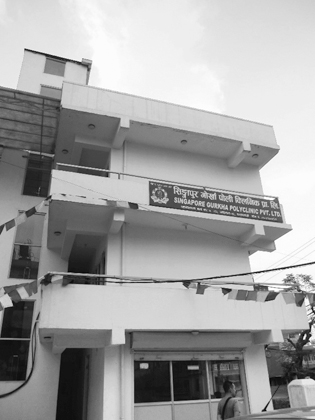
Given these stringent rules and criteria for Gurkha recruitment, it is no wonder that private training academies have sprung up over the years that offer training programs for interested applicants to prepare for the selection process. During one of my fieldwork trips to Pokhara, I noticed a couple of such training academies promoting their programs to attract potential recruits. Apart from the Gurkha Fitness Centre & Golf School (see figure 3.1) and the Gurkha Army Training School (figure 3.2) that I saw along the roads in Pokhara, Coburn (2018) likewise talks about these academies, where he had encountered a center called Gurkha Strength. Nepali youths would pay about twenty-five thousand Nepali rupees to join these programs. Training centers are also located in Dharan and Bhutwal in addition to other parts of Nepal (Coburn 2018).33 According to Piya (2020) who had researched similar training centers in Pokhara, these centers serve as “cultural intermediaries” given that Gurkha aspirants are trained to acquire a particular comportment and set of virtues associated with a Gurkha soldier. Such training comprises coaching aspirants to emphasize their links to Gurkha heritage in their family, or demonstrate their sense of discipline by adopting particular embodied behaviors and interview protocols, as I have discussed previously.
Figure 3.1. Gurkha Fitness Centre & Golf School, Pokhara. Source: Photo by author, 2012.Figure 3.2. The Gurkha Army Training School, Pokhara. Source: Photo by author, 2012.
The Gurkha recruitment exercise is not only about individual applicants. Rather, it is a family event, whereby loved ones are as well vested in hopes for a positive outcome of selection. As Chong (2014, 10–11) describes:
On the day of the final selection, anxious family members wait outside the gate of the British camp, hoping not to catch a glimpse of their sons walking down a long stretch of road to the exit. To see their son take the “walk of shame” would mean failure in being recruited. Many of the young men, some still in their late teenage years, are on the brink of tears by the time they exit the large metal gates, having come agonisingly close to a life in the military and a chance to leave a country where unemployment stood at forty percent.
Those youths who did not make the cut would either return to schools that they had previously left because of their Gurkha aspirations, or they would look for jobs in Kathmandu. Most, however still harbored dreams of securing work overseas. While some have ended up working in Malaysia, others have gotten jobs in Gulf countries (Coburn 2018). As for those who were successful in the Gurkha recruitment drive, these young Gurkhas would then be sent off to different countries depending on their individual deployment. While clear pathways were assigned to them in terms of being a Gurkha soldier or a police officer, their initial periods of recruit training and subsequent deployment took place in several different places, including Brunei, Hong Kong, Singapore, Malaysia, Cambodia, Belize, Jamaica, and the United Kingdom among other countries (Chong 2014). Already from the beginning of their career, the Gurkhas’ mobility was facilitated by military and police security training regimes that brought them to a range of different locations. It is to these varied experiences of life as a migrant Gurkha that I next turn.
Life as/Being a Gurkha
Uttam joined the Gurkhas in 1961, following tradition and the footsteps of his father who was at that time still serving as a British Gurkha. He explained:
And he was still serving while I was with them. You see? Wherever he went, we followed, because of course, being a part of the family. And I joined the army while I was in the army, with my parents… . It was a tradition during those days. I never thought I was going to be soldier because I was thinking of studying and looking for… . But in those days, your parents say you go for this and you go for this. And so I didn’t know when I was supposed to join the army. I just … They said, ok son, your name is put forth to the army, and you go! And I had to go.
He recollected his early training days in Malaysia, where he was posted to Sungei Petani, Kedah, for nine months of recruit training. The next stop was Hong Kong for a duration of three weeks, before he returned to Malaysia where he spent a subsequent half a year in the jungles of Sarawak:
Since our battalion was in Sarawak, after three weeks we went to Sarawak and it was all in jungle … for six months … From time to time we had to go although they had a basecamp which was quite far away from the border, from the Indonesian and Malaysian border, Sarawak. And from time to time we had to go over the border to kill the Indonesians. But if you went into the jungle you just cannot talk… . All camouflaged. Cooking was only done during the daytime. And no noise, you cannot make any noise. If you had to talk over the radio, you had to get … [inaudible]… . Everything was hand signal. For cooking, daytime then you cook, you cannot cook outside… . Maybe daytime was okay, with some foliage or branches. But night time, because if you put on your light, it can be seen. Very difficult …
Uttam’s account of field discipline (sound and light discipline to avoid raising enemy attention) above is one of many training narratives of hardships that depict how life as a trainee Gurkha commenced. As another example, Hari Bivor Karki joined the Gurkha Engineers (Malaya) in 1961. He recalls his recruit training days at Sungei Petani Camp where he “had a very hard life there” (Karki 2009, 140). He used to wake up at four in the morning every day in order to be ready for bed inspection, followed by breakfast at five thirty. Throughout the day, he had to attend physical training drills, regular parades, as well as jungle training. As a recruit, Karki also had to do twelve-hour shifts for guard duty as well as in sentry posts. Having met the recruitment expectations meted out by the British Army, successful Gurkha enlistees are then faced with a whole host of training regimes, depending on where they would have been posted to—Singapore, Hong Kong, Malaysia, or the United Kingdom, and elsewhere. Through the manifold accounts of training, survival, and hardships that Gurkhas undergo, I highlight stories of difficult moments and periods in their service career. I elucidate on narratives that depart from extant discourses and reportage in the wider literature and media, where stories of heroism and bravery abound in furthering the global reputation of these brave warriors. As Ram confided in me over our first interview: “When I was in the training I was shock, and sometimes I would cry, but my eldest brother he was there sometime in the week, and he would come and see then I was alright, but not too bad I was quite fit, I was all the time running.” Over and above extant accounts of gallantry, Gurkhas such as Ram have experienced different moments or periods of despair and tough training, given especially that the training routines meant they were usually not able to return home for a visit until after a few years.
Kumud described broadly, the different types of training that he had to undergo as a Gurkha: “Wah, so many training. How to kill enemy, how to hiding, how to save … [to] camouflage, how to save … people, how to treatment, how to first-aid. Disaster for the country, how to save these people, how to save people, all the people, anyone. And in Malaysia in general … so many snakes, so many have.” Where Kumud spoke of his experience in broader terms and where there is a hinted sense of danger, for instance, having to deal with snakes, Manohar furthered similar precarious and uncomfortable conditions he encountered in greater detail. Manohar has experienced both the Malayan Emergency (1948–60) and the Indonesian mass killings (1965–66) since his enlistment in 1959. He vividly narrated his memories of the tough conditions he faced, although it was not made clear as to which context he was referring to:
And, and then, they actually the already when we have a rotation… . Sometime we go to that Malaya place … since 1947, I went there as well. And then we all collect passport to Brunei, in Sarawak. And there was an Indonesian … in 1965 till 1968 like this… . Quite difficult. We have to stay and patrol at least, all these things. For a month, no change. Ah, you believe or not? Very heavy raining. And all leeches biting. And all the insect attacking. The mosquitoes, sandflies. You cannot do anything. And there was very difficult to get the drinking water. So we have a filter of the back of, made of like the cloth, to put the water… . And the bottle, something like that. And we boil it and drink. Otherwise get some sickness. Very very bad. At that time, the hospital, Malaya is many problem.
Arjun, whom I introduced in chapter 1, was recruited into Gurkha service at the age of twenty. The youngest among four brothers and five sisters, Arjun was the only one who enlisted as a Gurkha. His second brother did attempt to enlist, but was not successful. Two years earlier, Arjun had made several attempts to join the Indian Army. He had never harbored any plans to join the British Army, nor did he expect to have gone to Singapore subsequently. Upon Gurkha enlistment, Arjun was sent to Singapore to work in the GCSPF. At the beginning, he found it difficult to adjust to life overseas given that he was a young adult who had traveled outside of Nepal for the first time:
No family history in the army… . So that you know, I went to Singapore, everything new for me, sometimes very difficult to adjust ourselves… . I faced a lot of problems, especially discipline wise, you know, because I’m from village, I’m from third country, and also from village… . Not from the Kathmandu. If I’m from the Kathmandu, maybe no problem. I am from the village and I went to the first world country … so the system, first world country and third world country, it is very different, so it took time to adjust there so sometimes I got policeman, instructor… . But it happened all … what is called not intentionally … Unintentionally. I used to mistake.
In between adjusting to life abroad and juggling the rigors of training, Arjun made it a point to take night classes as well in order to learn English and to better his educational qualifications.34 Going to night school at seven each evening for three hours over four years had been difficult as he underwent training during the day before attending classes at night. By the end of those four years, Arjun had completed his GCE “O” levels. However, he had to stop taking classes once he was promoted to the rank of lance corporal. Since then, he had to train overseas, having traveled to such places as Belize for a section commander jungle course, as well as Australia and the United States among other countries.
Apart from undergoing intensive and arduous training, and thereafter to experience military life that at times place their lives in varying degrees of uncertainty or precarity, being a Gurkha abroad also meant having to cope with separated family life. This is because new recruits often have to serve at least three years without leave before they are allowed to go home to Nepal on long leave for a duration of six months. This was Arjun’s experience among several other Gurkhas whom I have met over the course of my research. After joining the Gurkhas in 1994, he was able to return home to Nepal three years later in 1997, on a six-month long leave. During this period of leave, these young Gurkhas usually settle down through an arranged marriage. They also consummate the marriage before they next return to service. It was during this leave period that Arjun met his wife through an arranged marriage. In his own words: “It is arranged marriage… . It is called… . We have no time to love [laughs].” Given this cycle of service and home visits taking place per three years, the birth of a first child usually occurs in the absence of his/her Gurkha father.
Hemant joined the Gurkhas in 1991, following the footsteps of his father who had also served in the British Army. Having first completed his basic military training in Hong Kong, Hemant was then posted to the Second Royal Gurkha Rifles, and later to the First Royal Gurkha Rifles. His Gurkha experiences include having carried out peacekeeping operations in Bosnia, Sierra-Leone, and Afghanistan. Where his first son was born in Nepal while he was in Brunei, Hemant’s second son was later born in the United Kingdom where he has been based since September 2008. Hemant’s account of having missed the birth of his first child owing to his deployment in Brunei illustrates my focus on moving beyond the image of Gurkhas as brave warriors in the wider historical/military narrative. He calls this narrative the “big history of the Gurkhas.” When Hemant first met his eldest son, the latter was already a two-and-a-half-year-old toddler:
There is … big history of the Gurkhas you know … I think you hear that about this painful, this very painful … Very young time when I have to [leave] from the family. It is very painful. Even myself, I join in 1991 and I went for course for up to three years to Nepal. And after three years I met my family. And I met when I went for my first leave… . We get five months leave after three years… . After three years. And I met in that time. Then, I came over to UK, when I posted to Brunei, in that time my first son is born in Nepal but I didn’t get the time… . And when I see him, my first son was walking, you know? He was talking and he was walking, imagine you know? It’s been a big gap.
Apart from Gurkhas not being able to be present at their child’s birth, Gurkha spouses are also not allowed to follow their husbands to their military base until a certain point in the Gurkha’s career where promotions and rank determine if wives/families may follow them (Uesugi 2019a).
The case of Lalbahadur Gurung attests to the separated family life that was the norm for Gurkha soldiers:
Also, I was slightly apprehensive about the prospect of an arranged marriage. When I left Nepal at the age of twelve (to go to Hong Kong where his Gurkha father was based), I had been a shepherd boy… . And then my father brought me to Hong Kong and I became a city boy. After that, I had spent three years in the British army, and all that goes with the social side of military life. Suddenly, on my first leave home, I am to marry a girl who had never been away from her village… . Now … we have been married twenty years, we have four children and my eldest daughter is nineteen. She was born seven months after I had returned to my unit after that first leave, and so I did not see her or my wife again until three years later. She sent me tiny little pictures of our daughter, but when I came home on leave I did not recognise her, nor she me. I was walking towards my father’s house and this little child ran past me. My sister cried out, “That is your daughter …” and tears welled up in my eyes. (Parker 1999, 235–36)
Lalbahadur’s experience, similar to Hemant’s, is one among many of his Gurkha comrades. As he put it: “This is how it has always been for the Gurkha soldiers. Most of them married in this way” (Parker 1999, 236). Interestingly, Lalbahadur raised a poignant point by juxtaposing the bravery of Gurkhas as opposed to their sentimentality as a husband and a father:
Believe me, although our image is one of fierce, fighting men, those occasions when we come home on leave and then have to return, leaving our wives, our children, our mothers at home, we are full of tears. It was very hard on the womenfolk and even now, when I talk of it to my wife—although I am retired from the British army—she cries. It brings back those memories of me leaving the village and returning to continue my duties in the British army. (Parker 1999, 236)
This scenario that Lalbahadur maudlinly described in effect led to a “split-household family structure” whereby “a migrant household maintains two family branches separated by geographical space and a national border” (Yamanaka 2005, 338). What keeps these two connected are the remittance flows, as well as occasional returns by migrant members. In Omkar and Ishayu’s case, they would seek help from their fellow Gurkha peers who would be returning home, to send to their families some money and gold. Omkar elaborated: “Every time when a friend goes Nepal, we send some money home and gold … She would be happy with that [referring to gold]. They waiting [for] us [to send home] … we [also] wrote some letters and send some parcels, like gold necklaces.” When I asked Omkar if the presents of gold were meant to keep their wives acquiesced due to their prolonged absences, he replied that such items would achieve that. Furthermore, “that’s the way they wait for us,” as Omkar added. In tandem, Adhikari and Seddon also point out the different cycles of Gurkha servicemen returning to Pokhara on their leave periods and how they channel their incomes:
It used to be commonly said in Pokhara that when an army serviceman returned home for the first time, he used to devote his savings to getting married, to improving his house and his status in the village and perhaps to buying land in the village. On the second return, he would buy land in Pokhara; and with the money from the sale of the land, the urban vendor also built a house. On the third return, he would bring money to build a house on the land previously acquired in Pokhara. This, roughly was the pattern of the three decades: the 1960s, the 1970s and the 1980s. (Adhikari and Seddon 2002, 104)
In these contexts, Glenn’s (1983) discussion on how it is usually the male migrants who would sojourn elsewhere in order to generate income, while left-behind females remain in the homeland where they are responsible for family functions, including reproduction, child-rearing, or looking after their in-laws and other family members, is germane. However, it remains to be seen as to whether the context of split-household economies in Nepal vis-à-vis Gurkhas families may shift to a “dual-wage earner household” (cf. Yamanaka 2005), given as well the pending possibility of female hopefuls wanting to join Gurkha service that was earlier raised.
Due to the separation of spouses and/or family members of the Gurkhas including young children, not all Gurkha wives would be able to manage the prolonged periods of split-household and separated family lives over time.35 As Fateh explained:
I’ve seen other friends like breaking up sometimes… . Bad miscommunication… . Hey, you’re spending three years here, your wife wanting you there, and you’re not there… . What do you do? And another three years and another three years … Ten, twelve years without husband, without wife, what’s the point of getting married?
Omkar shared how he had only spent a total of twenty months with his wife, over his Gurkha career that spanned fifteen years in all. Vasava, who was part of my group interview with Omkar and Ishayu also concurred that having only just over two years’ time to be with their wives over close to two decades of military service was unusual and difficult to manage. Where “many wives escaped with other people [or stayed] in [their] home” as Vasava noted, other wives according to Omkar had eloped and had given up on their “difficult marriage.”36 Vasava summed it up: “In Nepal when we [are] out, some [referring to Gurkhas] like Hong Kong or UK, see where you belong to [during your service]. Nepal, you know, some [referring to Gurkha wives] cannot wait too long you know. Young years everybody needs what they need. So they said go, they go… . Very, very difficult in that time.” The mobile-migratory nature of Gurkha service both in the military and police force renders split-household living a norm rather than an exception. Over prolonged periods of separation and absences, these trying cycles of serving and returning home proved consequential on the married and family lives of these migrant warriors. I elaborate on the absences of Gurkhas in their familial contexts in the next chapter when I foreground the experiences of their wives and children.
Beyond Gurkha Service
Gurkhas usually retire from the British Army or GCSPF at the age of forty-five or earlier, given that this age is the maximum one can work up to till retirement.37 As this is a fairly young age, retired Gurkhas usually embark on what is known as a “second career” in a variety of industries as mentioned earlier.38 While most are by then able to stay with their family in the same locale, others have continued to venture out of their homes to work elsewhere. They thereby lengthen the period of their absence away from their kin to take on another job after Gurkha service. They have held security jobs dispersed in several different countries as security contractors. For example, Coburn (2018) talks about the experiences of a few of his interlocutors who had taken on security positions in their postretirement years from Gurkha service. The wars which started in Afghanistan in 2001 and in Iraq in 2003 saw an increase in demand for experienced security contractors. This was when international private security companies turned to the Nepali Gurkhas as an easy solution (Coburn 2018). They were still “young and fit,” were “well trained” with “clear military experience,” and were “far less expensive than a white soldier from a Western country with similar qualifications” (Coburn 2018, 90).
Some of these ex-Gurkhas in Coburn’s (2018) research include—among several others—Jeshwal who worked as a security guard for the U.S. embassy in Afghanistan, or Sanjog who was employed by a private security firm to work as a platoon commander in Iraq. Then there were also other retirees who ran manpower firms that served as brokers in catering to security labor needs. These include the UN and its branches such as the UN Assistance Mission in Afghanistan, and the UN Development Program. A retired Gurkha police officer, Pun, ran such a firm in Kathmandu and recruited fellow Gurkha police officers for the UN, while retired Lieutenant Colonel Gurung managed a similar office that specialized in hiring security for casinos and hotels in Macau and in the Gulf (Coburn 2018). Jeshwal, who retired just before 1997 from the British Army, received a small amount of a few hundred pounds per month as pension. This amount differed rather substantially from those who had retired after that year and who received sums that were equivalent to British soldiers. Depending on rank and years of service, the post-1997 pension amount is estimated to be about a few thousand pounds per month. This amount was a marked increase from those who left Gurkha service in pre-1997 times. Through a broker firm based in Kathmandu, Jeshwal was recruited by Global Security, a company that had previously provided security for the U.S. embassy in Afghanistan.39 The firm had offered him a monthly salary of US$1,700 to work at the embassy. Living quarters for guards like him were situated near the embassy where occupants were housed based on nationality. As a result, Jeshwal and other Nepali guards hardly interacted with other employees. They mainly hung around one another, and only interacted with their American or European supervisors on a needs basis. In 2007, Global Security lost their contract to another firm, ArmorGroup, which wanted Jeshwal to stay on but with a salary cut of US$600. It was then that he decided to leave, and returned to Dharan to “enjoy his retirement” (Coburn 2018, 98).
Depending on the age and generation of Gurkhas, there are also other more elderly Gurkhas who are not able to work anymore. They are therefore reliant on the support of institutions both in the United Kingdom and Nepal. These include the Gurkha Welfare Trust (UK) and the British Gurkha Welfare Society (Uesugi 2019b). Such support also extends beyond Gurkha veterans to include widows. These institutions are crucial especially for retired servicemen who are not eligible for pension given that they have not served a minimum of fifteen years in the force. For those who do qualify for pensions, they invest their money in both land and housing in Pokhara. There are several thousand British Army ex-servicemen who do so, including business interest in the transport as well as hotel and restaurant sectors, and the establishment of finance companies (Adhikari and Seddon 2002).
Hemant spoke with me about a “resettlement course” that Gurkhas would take at the end of their army service, which would run between five and seven weeks.40 In the course, these Gurkha soldiers are trained with such skills as chauffeuring, plumbing, driving, among others, as a way of preparing them for life after Gurkha service. As Hemant put it: “It is very challenging for me because I served twenty-two years with the Gurkhas. After that, back to ‘civi’ [civilian] state is very challenging for me.” Resettlement training courses include such topics as agriculture, small businesses, construction, plumbing, and shipping among other trades and skills. Newer courses comprise business code and also civil laws. The main aim of these courses is to train Gurkha retirees to be apprised of how things worked in Nepal. This is given especially that they have left the country at an early age, and only returned in their late thirties or early forties. In sum, the “aim of the course was to integrate Gurkha to the society, make Gurkha known to the legal things as well as to encourage them to initiate investment in businesses” (Mani 2020, 6261). Getting retired Gurkhas acquainted with Nepal when they return indicates as well that the country or homeland from which they had left to take up Gurkha service has transformed over time. This is not unlike themselves as military or police migrant laborers who have similarly changed in their outlook, perspectives, or ways of doing things after having been away for a protracted period of time (Shams 2020).
Community-Building in Nepal
Apart from ex-Gurkhas who have taken on second-career jobs as I have discussed, there are Gurkha initiatives relating to community-building efforts undertaken on their retirement. These efforts take off in different parts of Nepal where ex-Gurkhas decide to return and to settle down. Such initiatives in terms of how they are organized and structured bring out important dimensions of belonging, politics, and what is at stake. I contend that bracketed belonging where community is concerned expresses in-group togetherness and out-group exclusion concurrently (cf. Guibernau 2013; Prabhat 2018), as I explain below. At the same time, pursuing these endeavors with the larger good of the community in mind would enhance the visibility of ex-Gurkhas in the contexts of Kathmandu and Pokhara. The succeeding discussion on the politics of belonging is related to the notion of “cultural citizenship,” which has to do with community activism as the main signifier and subjective experiences of belonging and membership beyond legal-political aspects (Pawley 2008; Qureshi and Zeitlyn 2013; Yuval-Davis 2006). To begin with, Banskota notes that
the British Gurkha soldiers became the first common people to get mass education in the country. They were also the first source of public contact with the outside world. They visited different countries … and worked side by side with nationals of different countries. This gave them an opportunity to familiarise themselves with new and progressive ideas abroad with which they compared what they found at home. On their return home from abroad they became the vehicle for spreading among their families, friends and communities the importance of education and development. (Banskota 1994, 166–67)
Moreover, such initiatives related to change in Nepal, among other reasons, were also embarked on by ex-Gurkhas in order to counter stereotypes of Gurkhas as fierce and loyal soldiers in the main (Aryal 2008; Bhandari 2021; Onta 1996; Thapa 2021; Uprety 2011) as my respondents explain below.
The Singapore Gurkha Polyclinic was established in Koteshwar, Kathmandu, in 2012 (see figure 3.3). It later moved to its new premises in Lalitpur, where the clinic was officially opened in 2018.41 The clinic is an initiative driven by retired Gurkhas from the SPF. When I paid a visit to Koteshwar in 2012, I was greeted by a total of seventeen ex-SPF Gurkhas who have invested in the clinic. Arjun, being one of them, had put in 100,000 Nepali rupees (approximately US$806) as his investment, this being the average amount. I recount this visit using my fieldnotes:
I was at first quite puzzled as to why ‘Singapore’ is in the name of the clinic when ‘Gurkha’ would have sufficed. Upon talking more to Udgam, as well as the Chairman and others, it is really an issue of enhancing the visibility of Singapore-Gurkhas, as they want to (1) show the Nepalese government that they are doing something for their country; (2) to differentiate from British Gurkhas since the British government has no contribution towards this clinic; (3) to encourage current Singapore-Gurkha servicemen to contribute; and (4) to eventually liaise with and attract doctors and medical personnel from Singapore to work at the polyclinic. (Fieldnotes, 7 May 2012)
Arjun explained to me that some of the facilities and discount rates offered at the clinic were meant only for the Gurkha community who had served in the SPF. The clinic is therefore representative of the Gurkhas’ experiences in and connections with Singapore, where they harness such knowledge and ties in order to contribute back in Nepal. Arjun elaborated:
So I think because we worked in Singapore many years, and then we saw the system, we saw all the offices right? And then we want our clinic also like that, like Singapore. We are trying to do that, but still we are not, because our clinic is still in a loss. So actually we want many things, but still we can’t, still we are not doing that. Maybe next time, once our clinic is running properly and running nicely, the patient flow is continued, so that we have many things to change, many things to upgrade.
Taking lessons and experiences garnered from Singapore, the new clinic based in Lalitpur highlights the Singapore connection in its introductory message that also echoes Arjun’s explanation above:
Singapore Gurkha Polyclinic is the outcome of the Ex-Singapore Police personnel who have had a high-class medical facilities whilst serving in Singapore and felt that the same can be achieved anywhere in the world. The only requirement was the “will to do.” All like-minded people came together and decided to give the society a different taste that was supported by a few doctors and staff of the organization.
Within a span of 6–12 months a group of Singapore Police Gurkhas decided to open the clinic. They were supported by a couple of good and well experienced doctors and nurses. Later they were joined by other retirees and also by some of the serving men from Singapore. The doors are open for all retires and serving personnel to be members of the polyclinic which is aiming to be a full fledged hospital. Official opening on 2 Mar 2012 was inaugurated by Insp.(Retd) Bhakta Bahadur Pun (91 yrs.) one of the pioneer of Gurkha Contingent in 1949. It was very good to see him feeling proud of what came in front of him after so many years of the retirement.42
There are aspirations for the clinic to eventually be developed into a “full fledge hospital” given that the medical costs that other hospitals charge are about “30 to 40 percent” more than what Singapore Gurkha Polyclinic is charging, as Arjun indicated to me. He emphasized that “we are not looking for dividends,” and “think maybe our clinic will be for many years” as a longer-term vision. In bracketing the Singapore-Gurkha and Singapore connection, Arjun underlined that investment into the clinic is “only for Gurkhas and also from Singapore. Only Singapore, not British Gurkhas.” This example therefore illustrates the limits of belonging in terms of resource contributions (Mustassari, Maki-Petaja-Leinonen, and Griffiths, 2017) to the community, as well as recipients of such resources that are together bracketed. While it includes Gurkhas who have worked in Singapore, it concurrently excludes similar others who had served in the British Army.
Retired Gurkha soldiers traverse different routes in their respective postretirement milieus. Since the 1970s, Gurkha retirees have contributed to the economic life of Pokhara, such as retired Gurung soldiers in Tamu settlements for example. That said, however, the life of a retired soldier is also perceived as one that is of “enforced leisure” (Pettigrew 2000, 16), given limited opportunities for jobs coupled with the high cost of living. In extending from Pettigrew, my interlocutors in Pohkara have organized themselves in different ways after Gurkha active service. Through the auspices of the Annapurna Community, four “institutes” have been established since 2009.43 These institutes represent efforts toward contributing to community building in Pokhara. They include (1) a cooperative (savings and credit) only for Gurkhas and their families (see figure 3.4); (2) a grocery shop that caters to the general public (see figure 3.5); (3) a Gurkhali Radio Station; and (4) a joint-venture jewelry shop. The chair of the community, Lagan, stated: “This [is] our country, [we] take the challenge, try to do something… . We are doing every bit to attract and unite our people … to highlight our people’s activities… . We make our identity here [in Pokhara]… not only [as] brave fighters … we can prove that we have other ways to contribute to this country.” Having served with the British Army for over twenty years, and having traveled to many places including Brunei and Singapore, Lagan reasoned that instead of “keeping the West with me … [I’d] rather expose [Nepal] to all these kind of things.” With an interest in harnessing the varied experiences that he had accumulated over the course of two decades of serving in the British Army, Lagan helped establish the four institutes as a way of fostering community bonds through self-help services. He also stated that beyond being Gurkhas, they would have “other ways to contribute to” Nepal, thereby indicating the need to transcend stereotypes of Gurkhas as “brave fighters.” Active Gurkhas and retired servicemen may be shareholders of these institutes, regardless of whether they are or were working with the British Army or the SPF. Gurkhas serving in the United Kingdom, or residing in Kathmandu or in Singapore, whether they are in active service or otherwise, all contribute to these four organizations. This differs from the case of the Singapore Gurkha Polyclinic. Their transnational contributions indicate the diasporic outreach and inflow of financial assistance or investment into Nepal, or what Seddon et al. (2002, 34) might term as the “(unrecognised) remittance economy.” This would also echo Yamanaka’s (2000) contention that as a result of the tradition of British Gurkha army service (to which I add Gurkha Singapore Police service), a remittance economy in Nepal has been created in both rural and urban areas. Given that the Gurkhas are the first foreign economic migrants of Nepal, also known as lahures (soldiers who have traveled abroad; Kiruppalini 2013), Thapa (2021) calls them “harbingers of modernity” who have helped shape Nepal’s modernity and development.
Figure 3.4. The Gurkhas Saving & Credit Cooperative Ltd, Pokhara. Source: Photo by author, 2012.Figure 3.5. Gurkha grocery store, Pokhara. Source: Photo by author, 2012.
Interestingly, Lagan delineated four categories of Gurkhas who have retired from active service. The four types of retired servicemen are, in his words:
“I had enough … I have pension … and want to do nothing.”
“They go for [a] second career.” (Usually in the security industry.)
“They … enjoy drinking, playing cards, gambling … womanizing.”
“[They get] involved with community and social work.”
Lagan, together with ex-Gurkhas who form individual working committees of each of the four institutes, belongs to the fourth category of retired Gurkhas, or what Cassarino (2004, 270) would call “actors of change.” Lagan explained why he decided to return to Nepal to settle down, despite a recent ruling in the United Kingdom which awarded ex-Gurkhas the right to remain in Britain:44
Having served … so many years outside the country, where … I think every single person, wish to … die … do something for everyone. So, my … resettlement, right to remain in the UK, I prefer myself not to go because you already spent so many years outside of your country, serve for others, so I decided myself to do something for the community, for the people, who need our help … . I learned something, I gained a lot of experience … so I decided to get involved in community, social service work.
Across the four institutes that have been established in the last few years, Lagan detailed the number of shareholders per institute, where he also mentioned the amount that each shareholder has to invest. For example, there are about 278 shareholders for the cooperative, and approximately 128 who have invested in the grocery shop, with amounts ranging between 25,000 and 500,000 Nepali rupees (approximately between US$201 and US$4,030). The minimum share for investing in the radio station, Lagan said, is 10,000 Nepali rupees (approximately US$80). Apart from disseminating local, regional, and international news, Gurkhali Radio 106 MHZ also broadcasts a weekly, one-hour program hosted by Lagan himself (figure 3.6). He interviewed ex-Gurkhas about their individual experiences of serving overseas. As for the jewelry shop (figure 3.7), he explained that Gurkha families would go there to purchase accessories for weddings and other special occasions, where they would receive a discount given their Gurkha background.
The four institutes that Lagan oversees represent a cultivated sense of belonging to Nepal or Pokhara as a way of contributing to the community. These institutes act as a platform for Lagan to articulate and further foster his belonging to Nepal, and specifically to Pokhara, by providing services and opportunities to fellow ex-Gurkhas. However, Lagan also pointed out that such contributions are bracketed only for Gurkhas and their families, and not non-Gurkha locals (in terms of investments). Comparatively, those who invest in the Kathmandu polyclinic need to be connected with Singapore, either as retired members of the GCSPF, or those who are currently in active service in Singapore. In this latter case, there is also bracketing occurring; not between Gurkhas and non-Gurkhas, and instead between Singapore- and non-Singapore Gurkhas.
Figure 3.6. Gurkhali radio station, Pokhara. Source: Photo by author, 2012.Figure 3.7. Gurkha and Barah Jewellery store, Pokhara. Source: Photo by author, 2012.
With an intention to transcend the image of Gurkhas as brave and loyal (and not good at business), and therefore to demonstrate that they can make contributions to the country, Lagan is however of the opinion that locals cannot be trusted. He therefore managed the four institutes for the Gurkha community exclusively. This then raises an interesting point with regard to the issue of belonging that is constructed on the basis of community services. Belonging as performed after return migration means the reestablishment of boundaries when one is back in the homeland. While belonging seems to be a desirable intention after having served a foreign country for two decades or more, such belonging in Nepal concurrently produces exclusionary mechanisms through bracketing approaches. As we see in Lagan’s case, exclusion of those not belonging to these Gurkha initiatives takes place as well. One might argue that, as return migrants, they have also changed in terms of the cultural and social frameworks that they have been exposed and subsequently subscribed to. This thereby leads to the bracketed distinction made between Gurkha migrants and nonmigrants, as well as Singapore-Gurkhas and non-Singapore Gurkhas in the context of Pokhara and Kathmandu respectively.
Diasporans who contribute to community building and who are away from Nepal is also a common phenomenon among Gurkhas living overseas as a form of diasporic engagement (Khanal 2013; Shivakoti 2019; Thomas, Smith, and Laurie, 2020; Van Hear 2015). Gopan, who is currently based in the United Kingdom after retiring from the British Army in 2006, had embarked on what he called the “ambulance project” in 2011–12. In his case, he had made arrangements to fly back to Nepal. He shared in greater detail:
We had a makeup plan to do something for our work place in our motherland, back in Nepal. And our committee had a word, we had discussed, and what should we do, for better, for Nepal? And everybody can to an idea, saying why don’t we buy two ambulance because where we born, it’s a small area, like mountain and hill. I used to be, when I was in Nepal, when I joined the Gurkhas, I walked three days to come to town to join in the Gurkhas. You know, three days I walk. My heart, my mind, I mean my everything, I know I have my life here, but I dearly love my country, my village you know? Always I want to do something for my village and for my country. And this suddenly come, wow, and committee says let me to coordinator, to organizing this ambulance project … we managed to raise over 50 million rupees, Nepalese rupees. That’s like 40,000, 45,000 pounds.
Gopan had earlier explained to me that he was the vice chairman of his district back home in Nepal. He was really very keen to do something for his “motherland,” for his “dear beloved country Nepal.” He continued:
So this coming 24 February, I am flying back to Nepal not only meet my team. We already contact Nepali government, the red cross. And then we going back to, and then the ambulance already order in India because has to be come from there. And government also has to write the letter. Takes quite a process and we all done it now. So 24 February we all going back to Nepal, and then going to handing over two ambulance. One is other village and one is my village. So two ambulances we are going to handing over to Red Cross in Nepal.
Not only did Gopan spearhead this ambulance project in contributing to his fellow Nepalese back in Nepal, he is also active in community service in the United Kingdom. He is involved in aiding older ex-Gurkhas who may not be as proficient in English as himself. Part of his volunteer work consists of arranging medical support and resources for elderly Gurkha diasporans, as well as helping to resolve pension issues, among others.
Diasporic connections and ties between Nepal and other countries are also manifested through the provision of aid to the former vis-à-vis a variety of aid channels (Sharma and Harper 2017).45 For example, Nepal was struck by massive earthquakes in April and May 2015.46 On 25 April, an earthquake measuring 7.8 magnitude hit near Kathmandu. Out of the seventy-five districts of Nepal, thirty-one were affected and fourteen were declared as “crisis-hit” (Shivakoti 2019). Affected districts, including Gorkha, Dhading, and Lamjung, were areas that Singapore Gurkhas came from. These were locales where they had lost their homes and property caused by the earthquake.47 Some of these Gurkhas were slated to fly to Nepal as part of a Home Team contingent sent by Singapore to assist with search and rescue efforts.48 Moreover, humanitarian organizations in Singapore, including the Red Cross and Mercy Relief, had sent relief items, emergency supplies, and disaster response teams to Nepal, on top of appealing for donations to help the cause.49 Former and present Gurkha children studying in Bartley Secondary School in Singapore also came together with the school to raise more than SGD$20,000 within a week. These funds were sent to Nepal through the Singapore Red Cross to contribute toward relief efforts.50 The British Army had also responded by sending approximately three hundred Gurkha soldiers in all to Nepal to help with the relief effort. These Gurkhas had made their way to villages and more remote hill areas in order to support current Gurkhas, veterans, and their families, and to construct shelters, and repair infrastructure. Their deployment back home formed a “vital element of the international response” given the Gurkhas’ “unique set of local knowledge, language skills and engineering experience.”51 Other Gurkha communities based in the United Kingdom including the British Gurkhas Community Winchester and Nepalese Community Winchester, worked together to raise funds for those in Nepal who have been affected.52 A report carried by Forces TV, a UK-based television channel that brings news on the British Armed Forces, registered this message:
For 200 years Nepal has given up the bravest of its young men to Britain—often in the knowledge that they may never return. Some 46,000 Nepalese soldiers having died fighting for the Crown and ultimately for the freedom of the people of the United Kingdom. Now it is time for us to fight for them. Members of the Nepalese and Gurkha community in the UK have been left feeling helpless as they watch endless scenes of their devastated Himalayan homeland. Desperate for information, many have been unable to contact loved ones, especially in the remote hill towns from where the British Army Gurkha Regiments draw their ranks. Nowhere is that growing sense of grief and frustration more keenly felt than in Aldershot. The garrison town is home to many of the 11,000 ex-Gurkhas and their families who have chosen to settle in the UK after completing their military service. There, in an extremely close-knit community—the like of which can only be forged from men having fought in combat together—people are well-versed in pooling resources, sharing information and providing support. The British political establishment has been quick to respond with word and deed. Among them the Deputy Prime Minister Nick Clegg, who told Sky News “The Gurkhas have done so much for us, we now need to support them in their hour of anxiety and need.”53
I highlight two key points concerning diasporic ties and belonging. Bracketed belonging has to do with a coexistence of both inclusionary and exclusionary practices that thread across diasporans dispersed in different places. Where inclusionary practices are concerned, these have to do with how Gurkhas and the wider Nepalese diasporic community are involved with diasporic engagement in relation to aid and other forms of humanitarian efforts as I have documented. These practices sustained transnational, affective ties vis-à-vis Nepal as a locale that bring these actors together in collective post-earthquake reconstruction efforts, as one example. In contrast, the rationale that underlies community-building efforts by returnee Gurkhas to Nepal point toward exclusionary mechanisms. In effect, such exclusionary bracketing distinguishes between Nepalese who are part of the Gurkha circuit as an in-group, and those who have not been associated with Gurkha service as an out-group. These dynamics reflect on barriers of or thresholds to belonging (Jones and Krzyzanowski 2011; Lems 2020) demarcated by these retired Gurkhas. As a result, probing into how and why bracketed belonging surfaces based on these contradistinctive practices of inclusion and exclusion thereby flesh out the complexities and geometries of belonging that is felt, parenthesized, and maintained. Different aspects of and approaches to belonging are contingent on the migrant trajectories of the Gurkhas and their present relationship with Nepal. The two examples of community efforts taking place in Kathmandu and Pokhara elucidate as well that migrants should not be taken as an internally consistent group (Jones and Krzyzanowski 2011) in relation to how they have approached bracketed belonging. This is also a point that I have earlier prefaced in the introductory chapter. Where diasporans may intersect in their varied engagements with Nepal, there are also segments of social division taking place between migrants and those who are nonmigrants in pursuits and practices of bracketed belonging.
On Citizenship and Home
While I have discussed ideas of homeland in chapter 1 and shown the differences in interpretations of where home is across Gurkhas and their children’s generations, I extend the analysis to now include their varied views on citizenship and the issue of who belongs. This is important especially when citizenship rights or possession are intimately tied to where one feels a sense of belonging as home, including other practical considerations of education, work, living standards, and other accompanying factors. Reading meanings of citizenship through the lens of home, residency, and belonging is an approach that Gurkhas and their families have adopted. A large majority of my interlocutors have noted that while they might be comfortable in their present location of living in Hong Kong or the United Kingdom, the eventual plan would be to return home to Nepal. Several reasons account for this sentiment and how their sense of home is rooted in their bracketed belonging that is traced to Nepal. Ex-Gurkhas who have worked and lived in Hong Kong hold differing views in terms of how long they plan to stay in the country vis-à-vis their residency eligibility. Both Uttam and Lakshan mentioned to me over separate interviews that one is eligible to apply for a permanent identity card on working in Hong Kong for seven consecutive years. For Uttam, his daughter possesses Hong Kong citizenship as she was born there. In his own case, he had worked for four years after Gurkha service in a security company as his second career. After these four years, he decided to return back to Nepal where his wife was, instead of continuing for another three years before he would acquire residency eligibility. In Lakshan’s case, he had fulfilled seven years of working in Hong Kong and thereby obtained the permanent ID. He told me that while some ex-Gurkhas who had embarked on their second career in Hong Kong subsequently moved to the United Kingdom (once the right to residency was permitted), he found “life [to be] easier” in Hong Kong. Ujesh agreed with Lakshan and further elaborated:
And in Hong Kong case, a lot of our people like to stay here rather than going back to UK. Simple is because our relation [referring to family]. We are concerned the relationship here. Another thing the weather. Another thing the food. We would like it here. And very near to go back to Nepal, only four hours. If you fly from UK to Nepal it take seventeen hours. That is the reason people who already established in Hong Kong, they wish to stay here. I know many in Hong Kong, they go back to UK and they are still here. But I always say that, in general, people who are above sixty, they want to go back to Nepal.
For those above sixty, one of the reasons that prompt them to return to Nepal is because of their investments there, including property and other assets according to Lakshan. In Parijat’s case, he called Nepal his “ancestral home”; he had chosen to return there from Hong Kong partly because of his farm which he references as his “ancestral property.” Ostensibly, ancestral ties (Ho 2019; Timalsina 2019) in the forms of home and property constitute one pertinent reason among others for Parijat to return to Nepal. Some ex-Gurkhas among my pool of informants have also expressed to me that they would wish to stay on in Hong Kong further. During the time of our meetings, at least, they harbored no concrete plans to return to Nepal. Where Nishad preferred to remain in Hong Kong because his children are working there and he was deterred as well by political instability in Nepal, Shahid has lived in Hong Kong for sixteen years. Aside from finding ease of access to public transportation and food in Hong Kong, other reasons as to why Shahid prefers to remain there include full medical coverage given that he possessed the permanent identity card.
In my group interview with Vasava, Omkar, and Ishayu in the United Kingdom, all three of them have expressed their eventual plan to go back to Nepal:
Vasava: When the children is [themselves established, they] can stay there [referring to the UK]. So no need to stay we are here. Because that time, we are getting very old, we need to read and thinking only. If you stay here [UK], you need to come and work, come and work, go and work, and pay money everything. Everything, everything… . If you go back to our country [Nepal], we have our own home. We can have own land so we can … time pass in our garden… . And relax… . So I’m thinking like that. So that’s why I’m not going to keep British passport. My Nepalese passport, I can only stay here, I can use the Nepalese passport no need to keep the British passport. The rest of my family have British, so if you are keep the British passport, our government … within five years, if you keep another country’s passport, they have limited visit so I’m not going back to my country to be … my mother land.
Omkar: We have a British passport. I have a British passport… . Whole family. But I don’t think we [referring to himself and his wife] are staying longer.
Ishayu: Because I’m proud to be a Nepalese even I get a British passport. That is my born, I mean heritage citizen …
For the three of them, the United Kingdom does not constitute their home. The United Kingdom is a place of work and thus “I don’t need to call it home here,” said Vasava. Ostensibly, most if not all of my respondents have shared that they will continue to stay on—either in Hong Kong or the United Kingdom—until their children have completed their education and would have become independent. In this manner, these Gurkhas have bracketed their sense of belonging in two ways. The first is that they are holding off their eventual return to Nepal owing to their children’s age and educational pursuits. The second is that political uncertainties in Nepal in the early years of the 2000s also prompted them to delay their going back to Nepal. In the end, Nepal is motherland and homeland for these Gurkhas; however, they do not have any wish to install this sense of belonging on their children, leaving the latter the option to decide what they would desire or aspire toward.
That said, however, Gurkhas themselves would continue to educate their children with Nepalese customs and traditions by way of maintaining links to Nepal, not unlike how the military maintains Nepalese religious and festive celebrations while they are overseas as I have previously addressed. Similar to Arjun and Ram’s varied efforts to inculcate the Nepalese language and practices among their children, which I discussed, Ishayu talked about his concern with keeping Nepalese customs alive for the children: “We are very cautious and we are very worried to keep our culture, customs to live. So we must teach our children. That’s why we have lots of programs, like cultural programs. So that means we can teach them, what we did.” Eknath was equally concerned that Gurkha children would be influenced by “British culture” and hence found it important to “teach them” with “our own traditional culture … so that they know what are our cultural values.” Resulting from this emphasis on the importance of Nepali culture, it is plausible to suggest that Gurkha children thereby experience dual belonging (Kananen 2020) in a sense where they learn all things Nepalese while growing up and living elsewhere. Gurkhas ensured that their children remain connected to their homeland on the basis of conveying and sustaining these different aspects of Nepali culture outside of Nepal as transnational practices (cf. Bose 2021). Engaging with such cultural practices is akin to “ ‘routinizing’ Nepaliness in their everyday lives” (Bhandari 2017, 127) in bracketing senses of belonging across generations.54 The difference between the children and their Gurkha parents is that where the former experienced Nepal vis-à-vis these practices and traditions as forms of cultural learning, the latter thought of their belonging to Nepal in territorial, geopolitical ways in addition to these cultural practices. For the children, what they experienced was usually a sense of being neither here nor there, as I explain in the next chapter. It is important to point these out given that they reflect on and reiterate the differentiated forms and degrees of how bracketed belonging ought to be comprehended—through interconnected practices, time, place, and territory that apply differently for each generation of diasporans. In this way, citizenship and belonging transcend formal status and rights. Rather, they crucially involve diasporans’ “everyday practice[s] of engagement” that also highlight the emotional and pragmatic components (Muller and Belloni 2020, 4). These components that are regarded or felt differently by different members and generations of the diaspora would also reflect on diasporic incongruity in terms of the definitions of where and what “home” is.
Belonging across generations also has to do with practical considerations. Gurkha children who learn the Nepalese language and customs do not necessarily acquire proficiency in totality. This is one concern Fateh had when I asked what his postretirement plans involved: “You want to go back Nepal? Wah, they say your kids are study here. They are small, they don’t speak Nepali. They’re illiterate in Nepali but they can write, what’s the point of taking them anymore. You’re torturing them, you know, mentally. I said oh, I can’t do that.” When I met Fateh in the United Kingdom in 2011, he had just retired from Gurkha service about eighteen months earlier. His father served in the British Army at the rank of captain and retired twenty-eight years later. Fateh’s two elder brothers were also Gurkhas, and he followed suit and enlisted in 1988. All three brothers were born in Singapore, and all subsequently joined the British Army. From recruitment in Pokhara, Fateh was posted to Hong Kong for recruit training over a period of nine months. After another deployment in Brunei that spanned five months, Fateh eventually came to the United Kingdom in 2000. Upon his retirement, Fateh opened a grocery store there. Given his residency status with the right to remain in the United Kingdom, Fateh was not, at that time of our meeting, concerned about applying for British citizenship.55 For him, he looked at the United Kingdom very differently from his children:
I wouldn’t say I call it home now, for me. For kids, it’s their home. They have their friends all these, schools. They are more … in everyday life, they are related here. Ours only the army and the friends we had. Now we finish our army career, we don’t have any other friends, no civilian friends… . So for us it’s difficult for us to say that this is my place, that we are going to serve in the army barracks and then we move on… . What about Hong Kong, what about Brunei? There are still our battalion there. What about Brunei? Do we call Brunei home? Do we call Hong Kong home? Or, Singapore I was born there, do I call Singapore my home? I don’t know … it’s a confusing time for all of us.
Contingent on an individual’s military and/or police career trajectory, including where one’s children were born and bred, the idea of “home” becomes one that is a fluid and contested notion. The notion also intertwines with the different life phases and social ties that one goes through and acquires over time. Together, these set of factors wield influence in how one approaches the shifting and parenthetical ideas of home, citizenship, and senses of belonging, contingent as well on temporality and the role of state and state policies on immigration and rights to abode, as I further elaborate in chapter 5.
The year 2015 marked two hundred years of Gurkha service with the British Army and long-standing bilateral relations between Nepal and the United Kingdom. Many events were held that year in celebration of this, including the installation of a Gurkha “memorial stone” in Riversley Park, Nuneaton, a Mount Everest climb and an Artic expedition at Ellesmere Island, and various regimental celebrations held in India and in Singapore, among many others.56 These different forms of celebrations come with media reportage reminders of the Gurkhas’ history and reputation as fierce fighters and loyal soldiers. Beyond the global reputation and image of the Gurkhas as brave warriors who were steadfastly loyal to the crown and who have been presented as fearless in public discourse, I presented different parts and aspects of their Gurkha career and beyond as migrants. The thematic lines of inquiry articulated herein are pertinent for a number of reasons. The first is to go beyond the popular and global image of the Gurkhas as martial warriors in the larger scheme of military contexts as well as the global security industry. This entails narrating and analyzing their varied experiences from the time that they were being recruited into the military and police forces, through their training and manifold postings across different parts of the world; to how they cope with family life; and their hopes, fears, and aspirations both while in Gurkha service and during the period after which they retire or go into a second career. Seldom have these relational domains of their experiences been comprehensively attended to in the wider literature as I have previously iterated and therefore become an exigent endeavor here in this book.
The second reason pertains to how their individual experiences captured here stand as important foil and counterpoints to the image of their bravery and masculinity contextualized within military environments over more than two hundred years and which I have addressed in the previous chapter. Over and above popular depictions of their varied military conquests, loyalty, and stalwart service, Gurkhas were also confronted with many instances in which they feared for their lives, or missed their families given protracted periods of time away from home and their loved ones. By attending to the above aspects vis-à-vis migration scholarship and other cognate domains of interest, I worked through these migratory experiences and phases of Gurkhas as migrant warriors, including how they approached senses of belonging based on shifting contexts of service, postings, and their postretirement milieu. Their diasporic narratives also characterize how bracketed belonging, from their perspective, is reasoned, planned, negotiated vis-à-vis residency/citizenship aspirations managed alongside the future education and prospects of their children. Where Gurkhas who have retired articulated their “homing desire” with aspirations for “eventual return” (Sinha 2022, 90) to Nepal in their conversations with me, “home” appears to be elsewhere for their children, including some of their wives.
As different generational members of the Gurkha diaspora who are associated with variegated roots and routes, Gurkhas and their wives and children comprehend and experience working and living overseas in differentiated manners. In a way, the Gurkhas made a conscious decision to join the army or police force and to leave Nepal (cf. Bhandari 2017). In contrast, their wives and children are away from Nepal owing to other circumstances of their respective marital ties, birth place, and social contexts of growing up, schooling, and work. While I employ the label of “Gurkha diaspora” as an umbrella conceptual placeholder that is to be differentiated from South Asian diasporas as discussed, I am not however subscribing to a singular Gurkha diaspora per se. This is because diasporan members’ lives and migratory routes are clearly much more heterogeneous than homogeneous, determined as well by institutional frameworks.
Given the contrastive backgrounds of Gurkhas, their wives, and children that underlie the mobile and transnational aspects of Gurkha family lives, it should not come as a surprise that belonging is differentially experienced and orchestrated based on their manifold migratory trajectories as this and the next chapter illustrate. The act of bracketing belonging therefore continues to be malleable, negotiated, and shifting over time, and which intersect with individual, familial, and structural possibilities and/or constraints. Just as notions and practices of citizenship and home are complex and nuanced, then so too would variegated ideas and experiences of belonging transpire within the same nexus of Gurkha recruitment, marital relations, and family building in both historical and contemporary milieus. I have examined the lived experiences of Gurkhas since the time of their enlistment up to retirement years; next I address the experiences of Gurkha wives and children.